|
Wales 2002: Exploring the castles and dramatic landscapes found in Mid-Wales, Shropshire, and South Wales. Our most ambitious castle trip ever, visiting 40 castles along with many other sites. (Boy were we tired!)
 Follow this link for a text-only version of this essay (pdf file) Follow this link for a text-only version of this essay (pdf file)
Places Visited:
Caerphilly Castle → Llanafan Fawr → Tinboeth Castle (missed!) → Abbey Cwmhir → Abbey Cwmhir Parish Church → Caer Beris Manor
Bleddfa Castle → Wigmore Castle → Hopton Castle → Clun Castle → Knucklas Castle → Dolforwyn Castle → Montgomery Castle → Hen Domen Castle
Ffridd Faldwyn Iron Age Hillfort → Builth Castle → Castell Dinas → Aberedw Castles 1 & 2 → Painscastle Castle → Brecon Castle
Cefnllys Castle → Castell Crug Eryr → New Radnor Castle → Old Radnor → Clifford Castle → Hay-on-Wye Castle → Hay-on-Wye Motte
Clyro Castle → Crickadarn Ringwork → Part II: South Wales → Llandovery Castle → Dinefwr Castle → Carmarthen Castle → Dryslwyn Castle
Talley Abbey → Dolaucothi Gold Mines → Strata Florida Abbey → Aberystwyth Castle → Kidwelly Castle → Laugharne Castle → St Clears Castle
Pencader Castle → Wiston Castle → Carew Castle → Manorbier Castle → Carreg Cennen Castle → Llangadog Castle → England: Bath
Glastonbury Abbey → Wells Cathedral

Part I: Mid Wales
The purpose of this page is to provide something of a description of the two week trip my wife and I made to Wales in April of 2002. As is always the case, the trip was part relaxation and part research involving the castles of Wales. It should be noted that what follows is not a detailed description of each castle and its history (although there will be some of that), but rather simply a brief account of some of our impressions of the castles we visited. As such, what follows is more travel essay than historical survey.
We spent much of our time in mid-Wales near the town of Builth Wells. A quick glance at any number of general guidebooks might lead one to believe that there are few historic sites to see in this remote part of Wales. Actually, nothing could be further from the truth. This region is positively littered with ancient burial mounds, standing stones, Iron Age hillforts, Roman ruins, early-medieval religious sites, and, yes, castles. In terms of the latter, although there are no substantial masonry castles in mid-Wales, there are nevertheless many interesting castle sites with lesser remains to be explored.
Although we revisited several sites on this year's trip, most of the castles we were brand new to us. (How about that? Brand new 800-year-old castles! :-) Again, many of these were of the simple motte-and-bailey variety located on private land. As such, it was necessary to seek permission before visiting some of the sites, something that resulted in us having several friendly and enjoyable conversations with the owners of the castles. Throughout the trip the people we spoke with were genuinely friendly and very accommodating in granting us permission to visit castles located on their property, and for that we are profoundly grateful.
Again, visiting these lesser-known sites was the primary objective of the trip, and in that we enjoyed great success. I wasn’t quite sure how I would react to these castles, wondering at times if they would truly be worth visiting. By the end of the trip I was absolutely hooked on them. (You're not really surprised, are you? :-) As many of you already know, some castle sites are very interesting despite the lack of masonry remains. I have to confess that the challenge of locating some of these remote sites accounts for some of the attraction these castles hold; some are found atop remote hills, others deep in the woods, and some in the middle of a farmer’s field. Finding these sites then presents a challenge even if the "hunter" is armed with the latest OS maps and site surveys.
The preceding notwithstanding we began our two week trip by revisiting a castle that in no way falls into the "lesser" category.
It had been 10 years since my wife and I visited Caerphilly Castle, Britain’s 2nd largest Behind Windsor. Unlike our last visit, this time we spent several hours exploring the castle and town. Although the weather forecast for the day had called for clouds and drizzle, it was bright and sunny as we parked the car near the public park leading to the castle. From here a lazy path winds its way around Caerphilly’s artificial lake towards the town and castle. This is actually the best way to approach the site because the short walk allows one to appreciate the castle and its impressive water defenses from across the lake.
We decided to first grab a quick lunch at the pub overlooking the castle. Although the pub was recommended by the 1999 CAMRA Good Beer Guide, ownership had changed hands since then and I was disappointed by the bland selection of ales being offered (although the food was good).
Following lunch we decided to take on the castle. As many of you know, Caerphilly is one of a select few castles in Britain that can be described as giving visitors the complete package. The castle’s impressive remains are supplemented by several on-site exhibits to help visitors understand not only the history of the castle, but what it was actually like to live and work in one. In addition to on-site educational materials, Caerphilly features working siege engines, an impressive medieval hall with its flooring, roofing and furniture all intact, and an interesting section of castle wall displaying its defensive medieval wooden platform or hoarding, something of a rarity in British castles. There are also interior passageways and other towers and halls to be explored at Caerphilly, all of which contribute to the complete castle experience that was alluded to earlier.
Caerphilly Castle (below) was the first truly concentric castle constructed in Wales. It was the high-tech castle of it's day, a tremendous military engineering achievement, and a tribute to its builder, Gilbert de Clare. Many say that the great Edwardian castles of North Wales were patterned after Caerphilly.
 |
By mid-afternoon it was time to leave and head for our accommodations near Builth; there would be no more castle hunting on this first day. It took us a couple of hours to finally arrive at Cwm Chwefru Cottages, a small group of lovely safe-catering accommodations located down a one lane track off the B road between Newbridge-on-Wye and Beulah. This was one of several time-share exchanges we've enjoyed in Wales, and it's a great way to save money. All of our exchanges have been self-catering, and we like that. The holiday cottages are at the end of a long, narrow lane, wide enough for only a single vehicle, and it takes about 10 minutes to reach the resort from the main road. Not to worry. The drive down the lane provides a glimpse of what lies ahead. As the lane ends you break out into a clearing where the cottages are found, fronted by a lake and framed by the mountains. Another spectacular and isolated accommodation. We stayed in the "Kingfisher" cottage, a large 2-bedroom cottage on the top floor with a full kitchen, living room and dining area. Our living room window looked out onto the lake, grazing sheep, and the mountains. This was mainly a family-oriented resort with a swimming pool, sauna, indoor game room, and tennis courts. It was a relaxing and perfect base for exploring of castles in mid-Wales.
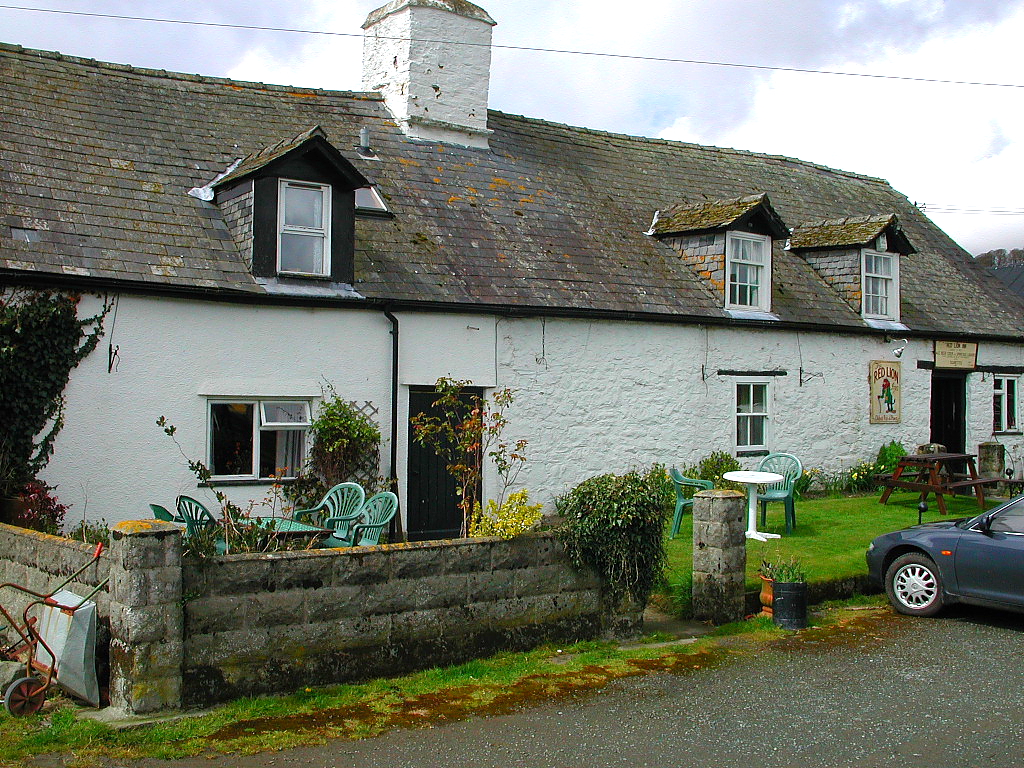
We enjoyed dinner later that night at the nearby Red Lion Pub (below) located in the tiny village of Llanafan Fawr. The pub dates to the 12th century and serves excellent food and ale. The proprietor of the pub has spent a lot of time researching the rich history of the area surrounding the pub, the fascinating details of which can be found by following the link above.
 |
The next morning we awoke to cloudy and misty skies, one of only three such days of the entire trip. After breakfast we decided to begin the day's activities by seeking out the impressive earthwork remains of Tinboeth Castle just up the road from our accommodations. Armed with our OS map and two descriptions of how to get to the site we set off in search of our quarry. After passing the spot several times, we finally located the public footpath leading to the castle, the remains of which rest high on a hill above the A road to Newtown. It had been raining that morning and the ground was wet, which made climbing the steep hill a bit difficult, even with good boots.
We finally made it to the summit of the hill, but the castle was nowhere to be seen. I rechecked my OS map and it certainly looked like we were in the right location. Then, as I began looking at the countryside around me, I finally saw the castle - on the hill opposite! We had climbed the wrong hill, and, given the weather conditions, we were not keen to attempt the correct one. Fortunately, this initial bit of bad luck proved to be an aberration as we managed to locate just about every other site we attempted during the next two weeks.
After failing to capture Tinboeth, our next quarry was nearby Abbey Cwmhir. Although the ruins of the abbey are slight, at one time there were plans to make Abbey Cwmhir the largest Cistercian monastery in all of Wales. The abbey has a special place in history because it is said that the headless body of Llywelyn ap Gruffydd (the Last) was buried here in 1282 after his death in a minor skirmish nearby. Although the exact spot where the last native prince of Wales rests is unknown, it is thought to be somewhere near the abbey’s high alter. Today, a memorial slab marks the former site of the alter.
The ruins are signposted and lie in a farmers field just outside the small village. Access to the site is provided courtesy of the land owner, and we did not need to seek permission in advance to visit the ruins. Just follow the signpost and make sure you close the gate! Although the weather cleared by the time we left the site, fog was on the ground when we arrived which gave the ruins a somewhat somber if not eerie appearance, perhaps somewhat in keeping with the sad fate of Llywelyn ap Gruffydd.
 |
At the ruins themselves, walls, some of which still stand to over 10 feet high, indicate the general plan of the abbey nave, although beyond this there is little else to see at the site (besides the beautiful countryside). We concluded our trip to Abbey Cwmhir with a visit to the local church. By this time it was time for lunch but unfortunately the local pub was closed. After finding a grocery store in Llandridnod Wells to stock up on food, we headed back to our accommodations for a bit of rest and relaxation before our dinner reservations later that evening.
That evening we had a lovely dinner at Caer Beris Manor in Builth Wells. The occasion was our 18th anniversary and we enjoyed delicious food and good wine. Caer Beris is a restored Tudor manor house, the former home of Lord Swansea. Later I learned that our table in the dining room that night looked out towards the site of a minor Norman castle located on the grounds! (It's difficult to get away from castles in this part of Wales :-)
The next day we awoke to beautiful, sunny weather. Following breakfast we decided to devote this day to visiting some major English castles located just over the border, however our first and last castles of the day were located in Wales. We really didn’t see the first one, Bleddfa, rather we simply took photographs of the overgrown motte from the road below. The second site was different, and in fact had been one of my main targets of the trip - Wigmore Castle. Here’s why.
Wigmore Castle in Herefordshire was at one time the seat of power for the infamous Mortimer family of the Marches and had been a much-neglected ruin for hundreds of years. Then, in the late 1990s 1 million pounds was secured by English Heritage, who decided to take a minimalist approach to conserving the castle. Instead of clearing, excavating and restoring the site in the traditional manner, they chose instead to temporarily remove the lush vegetation choking the site, stabilize the ruin, then replace the vegetation, leaving the castle as "a romantic ruin". While some agreed with this approach, arguing (probably correctly) that a million pounds was insufficient to undertake a proper excavation, others lamented at the archaeological opportunities that would be lost in such a scheme.
I was anxious to see the site for myself so I could make up my own mind. And now I have. Let me first say that Wigmore Castle is a wonderful ruin that is very much worth visiting. We spent a marvelous afternoon there exploring as much of the site as we could, and I would definitely recommend Wigmore as one of the best and most interesting castle sites in all of Herefordshire.
That said, having also now seen the results of other recently completed castle restoration projects in Wales, namely, Dolforwyn, Dryslwyn and Dinefwr, I found myself spending much of my time at Wigmore lamenting what could have been had a traditional investigation been undertaken. Although there are certainly impressive masonry remains to be seen and explored at the site, much of this once-great castle still lies buried beneath the ground. There’s even something of a cruel tease on one of the information sign posts leading to the castle, which states something to the effect that interesting artifacts were discovered during a preliminary excavation of the site!
Wigmore Castle commands a fine position on a hill overlooking the scenic Herefordshire countryside. The gatehouse is quite impressive, and the tall motte with its keep still dominates the site. Also surviving are tall sections of curtain wall, along with other impressive bits of towers and halls. Unfortunately, the brush and other growth makes it difficult to see, yet alone explore some parts of the castle.
 |
To be fair, English Heritage has done some impressive work at Wigmore in regards to stabilizing areas of the castle that were in imminent danger of collapse, and with this important work there can be no argument. In this regard, it was a job well done.
For those who have never seen the dramatic results that can be achieved when the traditional approach to castle conservation is used, I’m sure that the ruins at Wigmore would seem both wonderful and romantic. (In fact, they are.) The problem is, I am not such a person. The next day, as I was standing atop the impressive, once buried, now extensively-excavated Welsh castle at Dolforwyn, I couldn’t keep my thoughts from returning to Wigmore and the lost opportunities there.
Following lunch in a pub in the village, (one that served good local ale), it was up road in search of Hopton Castle, located in the village of the same name. I had seen several photographs of the site prior to our visit, however they failed to convey the tremendous size of Hopton’s keep (really the only surviving masonry portion of the castle). It was huge! Unfortunately, the site was fenced off and there didn’t seem to be anyone around to ask permission to visit the site, so we had to content ourselves with photographing the castle from the road and from an adjacent field.
The keep at Hopton rests on a large, noticeable mound and is nearly complete on all four sides. The stone seems to have something of a reddish hue, and there are some wonderful surviving exterior details in the windows and in ground-level entrance door to the keep. Fortunately, we were able to capture much of this detail using the camera’s telephoto lens, the results of which can be seen by visiting our Hopton Castle page. Hopton was the first of many castles that surprised us on this trip, either by their greater-than-expected size or the greater-than-expected extent of surviving ruins.
 |
Next it was on to lovely Clun Castle. The castle is situated on the English side of the border of Wales in the town of Clun, in a public park overlooking the town and the beautiful countryside. There's a car park located conveniently next to the park with and a path going over the stream and leading directly to the castle. The ruins of Clun are perched dramatically on a tall motte easily commanding the valley below. The bulk of the ruins at Clun consist of a large keep resting on top of the motte, along with a substantial section of a hall with one side of its foundations curiously built into the steep slope of the motte. The large keep is just about complete to battlement height on three of its four sides, and the interior of the keep retains substantial detailing in its surviving windows and fireplaces. After exploring these ruins we descended the motte to survey the castle from ground level. From here the height of the motte at Clun is even more impressive.
Although perhaps not as well known as other castles in the region, there is a lot to like about Clun Castle. The site offers free access, and features a still-impressive motte containing substantial and detailed masonry remains, with beautiful views of the surrounding countryside. What's not to like!
 |
By this time it was late in the afternoon, but we still had one more site to visit back in Wales on our way home. Knucklas Castle is located high on a hill overlooking the town of the same name. The modest stone castle was probably built in the 1240s by the Mortimers and was apparently destroyed by Llywelyn ap Gruffydd in 1262. The castle's fate after that is less certain. Although there are substantial portions of this masonry castle buried just below the ground, the fact that there is no surviving above-ground masonry or substantial mounds to indicate the positions of towers and walls, makes interpretation of this site difficult. Nevertheless, a climb to the summit of Knucklas is rewarded by commanding views of the surrounding countryside.
 |
The next morning we got up bright and early and made our way north towards the day's primary goal - the Welsh castle of Dolforwyn near the town of Montgomery. First we stopped in the town of Newtown. It was market day and we enjoyed spending time in the busy town taking in the various items for sale lining the main street. Afterwards we attempted to find the motte located just outside the town but were frustrated in the effort by obstacles that presented easy access to the site. We decided instead to head up the road to Dolforwyn.
Dolforwyn Castle is somewhat unique in Welsh history as it is claimed that it is the only native Welsh castle built entirely by Llywelyn ap Gruffydd (the Last). Llywelyn built the castle in the early 1270s which was taken by King Edward I as a direct threat to the nearby English castle at Montgomery. After being ordered by the king to cease construction at Dolforwyn, Llywelyn issued his famous reply saying that, as Prince of Wales, he did not need the king's permission to build a castle within his own territory. Some historians feel that Llywelyn's castle at Dolforwyn was the last straw in a chain of events that brought the last native Prince of Wales into a state of war with King Edward. Unfortunately, Llywelyn's hold on Dolforwyn did not last long, and the castle was captured by the English in 1277, only a few years after it was completed.
Until recently, this important Welsh castle lay all but forgotten and buried beneath the ground. Indeed, photographs of the site from the early 1980s show a series of grassy mounds interrupted by a single piece of masonry protruding forlornly from the ground. The transformation of the castle since then has been nothing short of amazing. My wife and I had visited the site in 1996, when the castle was about 2/3 excavated, and our return this year was even more stunning.
 |
 |
 |
When we visited the site in 1996, much of the southern portion of the castle, the curtain wall, the keep, two gateways, and some of a round tower on the northeast side of the castle, had already been excavated, however most of the northern side of the castle was still buried some 10-20 feet below the ground. The northern side has now been excavated and there have been some exciting finds here. A Welsh D-tower has been uncovered, along with a hall block east of the tower. A large storage cellar some 20 feet below the ground was also discovered, a feature that had been mentioned by certain contemporary documents. In addition, the round tower on the northeast side of the castle has been further excavated so that one can now better appreciate it's size and position.
The excavation at Dolforwyn has revealed a wealth of new information that is causing a reinterpretation of the form and function of the native Welsh Castle. The books are literally being rewritten based on what's been found here and at other native-built sites. It's difficult to express the tremendous feeling of satisfaction I felt as I stood atop the ruins of this important yet previously ignored chapter of Welsh history. In my opinion, the resurrection of Dolforwyn Castle is a great success story that argues directly against the approach taken at Wigmore.
Next it was on to nearby Montgomery Castle in the town of Montgomery. We first stopped at the Dragon Hotel for a bite of lunch and were rewarded with good food (and more importantly) good ale! As was the case with Dolforwyn, this was our second visit to Montgomery, and although the castle looks the same as it did in 1996, I had forgotten how impressive this ruin is. The approach to the castle is from the town or car park and leads you through the now mostly-ruined outer ward, across a modern draw bridge leading to the gate passage into the castle's inner ward. The gatehouse tower building is still impressive with ground level rooms and portcullis grooves surviving on both sides of the passage. The buildings of the inner ward mostly destroyed down their footings, although there are interesting surviving details in the kitchen and brew house.
To get a better sense of the castle you need to walk around the base (ditch) of Montgomery. From this vantage one can better appreciate the extent of the surviving ruins and the castle's strategic siting on a large outcropping of rock commanding the ground far below. The stretch of curtain wall on the eastern side of the inner ward in particularly impressive.
 |
Having experienced the excitement of Dolforwyn and the impressive castle at Montgomery, we felt that there couldn't be much more excitement left in this day. Of course we were wrong. About a mile down the road lies the remains of the forerunner to Montgomery Castle, a motte and bailey today known as Hen Domen. Although Hen Domen played a modest role in the history of the Welsh Marches, it is nevertheless an important castle because of the excavation work initiated there several decades ago by the late Philip Barker. Barker eventually teamed with Robert Higham to produce an important book based on their excavations at Hen Domen, titled "Timber Castles," a book that greatly increased our understanding of this previously little-understood subject.
We pulled into Hen Domen farm in search of the owner in order to seek permission to visit the site. After several minutes we were met Mr. John Wainwright, who graciously consented to allowing us to visit and photograph the site. Although Hen Domen was apparently never fortified in stone, this is nevertheless an impressive site. Two different sets of ditches, one of which is still quite deep, protect the large motte that remains in excellent condition. As with other motte and bailey sites I encountered on this trip, I was surprised at the size of the motte and surviving ditch work. The tall motte lies on the western side of the site, overlooking a modest inner bailey to the east. Entrance to the castle was apparently gained through a gateway on the eastern side of the bailey, and is still apparent today. The western quarter of the motte along with the entire western side of the ditch was obscured by vegetation, however the remainder of the motte was clear and offered a wide view of the bailey, ditches and outer ward to the east.
 |
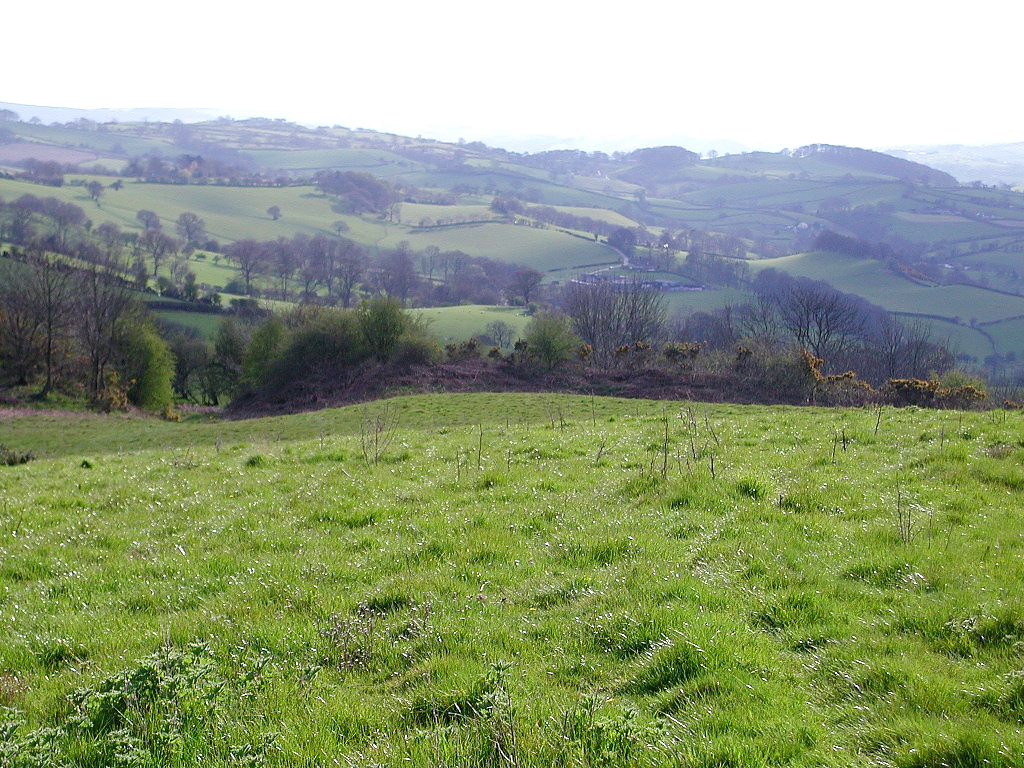
Returning to the farm we spent some time chatting with Mr Wainwright, who gladly told us about several experiences he had had over the years with excavators, visitors to the site, and with Cadw: Welsh Historic Monuments. Before we left he recommended that we visit the Iron Age hillfort on the hill between Hen Domen and Montgomery for better views of the surrounding countryside. We followed his advice and soon found ourselves climbing the hill to the summit of Ffridd Faldwyn the aforementioned hillfort. Unlike other hillforts we've visited, the fortifications are difficult to appreciate from the ground, as the banks and ditches protecting the site are not very apparent. Nevertheless, Mr Wainwright was correct in saying that there are wonderful views of the countryside from the summit of the fort. Additionally, I found it interesting that you can see both Hen Domen and Montgomery Castle from the top of the hill, the only time I've really been able to appreciate the relative sitings of these two castles.
 |
It had been quite a day. We were dazzled by the results at Dolforwyn, impressed by the castle at Montgomery, and awed by the opportunity to finally explore Hen Domen (an experience aided by Mr Wainwright's kind hospitality). Surely, after all this, the following day would be one of rest and relaxation. Guess again!
We began the next morning with a quick visit to nearby Builth Wells castle located in the town of the same name. The castle at Builth began as a modest Norman castle but was later transformed into a large and impressive fortress by Edward I. Builth has its place in Welsh history because the garrison here refused to support Llywelyn ap Gruffydd when he and his 7,000-man army came calling on the castle shortly before Llywelyn's untimely death in December of 1282. In the post-medieval era as Builth fell into ruin, the stone from this once impressive castle was removed and used elsewhere. Today, only the impressive motte and tall banks and ditches stand to testify to the castle's former glory. Even so, the motte and ditches at Builth were some of the most impressive we encountered.
 |
The real target of the day was a hike to the summit of Bwlch y Dinas Castle, also known as Castell Dinas, about three miles south of Talgarth. Bwlch y Dinas is a Norman castle dating to the middle of the 12th century, and the castle experienced all the fortunes and misfortunes as others in the region. Again, we were required to climb a steep hill to reach this castle, but this time we rewarded with outstanding views of the surrounding countryside, and we also had the opportunity to explore at least some masonry remnants. Enough survives at Bwlch y Dinas so that a basic plan of the castle can be discerned from the ground. The tallest point of the castle is the mound containing the remains of the collapsed keep, which at first glance appears to be a motte. There are (low) surviving sections of curtain wall to the east, and on the northeast side are the remains of a mural tower. We were very satisfied with exploring this site, and would have lingered longer there had it not been for the seemingly unrelenting gusts of wind.
 |
We ended the day with a visit to Aberedw, site of two different castles. The first castle at Aberedw is thought to be Welsh in origin It is found down a path that leads from the back of the church along a stream. There you'll find a tall motte protected by very steep drop to a stream below on one side, and by a weak ditch on the other. Legend claims that Llywelyn ap Gruffydd visited this castle with his men shortly before his death, thereby assuring the castle's place in Welsh history. By the time we had finished with this site it was late in the evening so we decided to save our hunt for Aberedw for the following day.
We returned to the village of Aberedw the following day, and armed with the proper OS map, soon found the second castle at Aberedw. Aberedw II is a modest Norman masonry castle that was built following the defeat of Llywelyn when the first Welsh castle became redundant. Aberedw II consists of four corner towers connected by a curtain wall protecting a modest-sized courtyard. In more modern times, a railroad bed was cut about a third of the way through the eastern side of site, destroying much of that side of the castle. Nevertheless, like so many others on this trip, Aberedw II proved to be something of a surprise to me. Having read about the castle and seen a couple of photographs of the site, I had reached the conclusion that there was very little masonry left to see. As it turns out, I was not correct in this assumption. Although the courtyard of the castle is much overgrown, I was surprised to discover that two of the towers at Aberedw II are very apparent, and the two towers partially destroyed by the railroad bed are still identifiable. In addition, several recognizable sections of curtain wall survive, albeit to a height of only 3 to 4 feet.
We were met at the site by the farmer who owns the land on which both Aberedw I (below 1) and II (below 2) reside, who had no objections to us surveying the site. We chatted for a while before a light rain forced us to say our farewells and head for our next quarry. Although I can’t exactly say why, I really liked the two castles at Aberedw. Perhaps it was the tranquility of the location, first castle’s association with Llywelyn, or maybe it was because we got two castles for the price of one! For whatever reason, this was one of my favorite sites.
 |
 |
Over the years I've found that overhead photographs of a castle sometimes create difficulties in gauging the true scale of a site. Although overhead photographs can be helpful in revealing the layout of a castle, these long distance views often make it difficult to judge the ground-level extent of the ruins. I had seen several overhead photographs of Painscastle over the years, and, as such, I was largely unprepared for the tremendous earthworks found at this very castle, our next stop for the day.
This is yet another Norman castle that was destroyed and rebuilt several times. In it’s final incarnation Painscastle Castle was a large impressive stone fortress that unfortunately shared the fate of many other masonry castles in Wales; it was robbed of its stone and today no above-ground masonry survives. Still, although only earthworks survive in Painscastle, they are the most impressive I’ve ever seen. (These suckers are huge!) The banks and ditches surrounding the motte are tall and deep, and the top of the bank is wide enough for two people to walk comfortably shoulder to shoulder across it. Other layers of banks and ditches surrounding the site are equally impressive. Although no masonry survives, the banks and ditches and the mounds of buried rubble make it possible for one to gain an appreciation for the layout of the castle.
 |
We first sought permission to visit the site at the farmhouse in front of the castle, and were soon escorted to the base of the motte by the wife and mother of the family who owned the handsome farm surrounding the site. She was very interested in the history of the castle and appeared to enjoy telling us something about her various experiences there (She told us she had lived there for most of her life.) We were escorted a good deal of the way by two of the three family dogs who were very insistent that we play fetch the stick with them. Again, this was an impressive site that was made more enjoyable by the hospitality we were shown by the owners. We left Painscastle in awe of the most substantial earthworks we had yet encountered, ready for our next adventure!
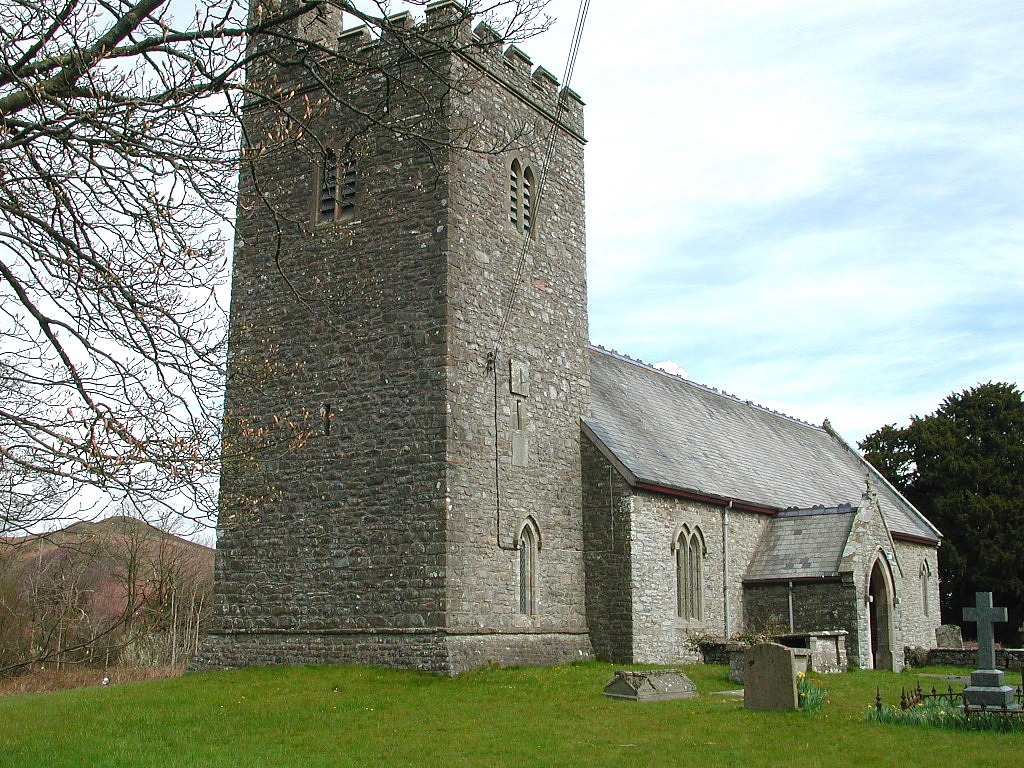
We returned to Llanfan Fawr and began the new day by exploring the area around the church. The Church at Llanfan Fawr as an interesting site. Archaeologists have determined in recent years that the church rests on an Iron Age mound surrounded by a deep ditch with an outer circular wall. The church is dedicated to the Welsh St Afan, whose flat tomb slab is said to lie in the church cemetery, not too distant from 2,000 year-old Yew trees. The church also features carved stones in the porch at the church from the 7th - 9th centuries, and a 7th-century stone pillar inside. Truly this is a site with some impressive and lengthy history. We also visited a site near the Red Lion pub that could be a ringwork castle, but is more likely some type of ringwork structure associated with the church, similar to the one found at Old Radnor. Our guide for much of our tour of the area was Adrian Foster, the proprietor of the Red Lion. He had recently written a history of the church and surrounds, which can be found by following the link above. He also pours a good pint! Thanks for your hospitality Adrian!
 |
The following morning we make a quick stop to photograph Brecon Castle before heading to our first new castle of the day. Cefnllys Castle is another two-for-one castle site (Cefnllys I & Cefnllys II) with two different castles occupying the same steep plateau with a later church at below. Accordant to historian Paul Martin Remfry:
| The main or northern castle was built by the young Roger Mortimer (born 1231) on behalf of his father Ralph (c.1185-1246) between 1240 and 1245. The castle was taken from Roger's steward, Hywel ap Meurig, a little before 27 November 1262, by the attackers scaling the walls and slaying the gatekeepers 'by treachery', according to the Welsh Bruts. Hywel and his wife, sons and daughters were then imprisoned and the castle was fired by the victorious rebels of Maelienydd, who were soon re-enforced by an army under the princes of Deheubarth and Prince Llywelyn's constable. |
Mr Remfry goes on to explain that the castle witnessed several significant battles between the King, his Marcher Lords, and the Welsh. It's one of those sites where, while little remains, the events that unfolded here were significant. We made the steep climb to the summit and explored both castles, one on each end of the plateau. It was easy to see why this site was chosen as it easily commands the surrounding valley. What remains today are several large, tall grassy mounds, deep ditches, and large amounts of stone and rubble strewn throughout the site (plus sheep). And, of course the views from the plateau are outstanding. Cefnllys is just the type of site I love to explore; a lost castle with still enough to explore, and a significant history in the warfare between Welsh and Normans. We remained here for about an hour before climbing back down and visiting the church. Another great castle conquered!
 |
  |
Our next destination was the town of New Radnor and it's motte castle. On the way we stopped to photograph the remains of Castell Crug Eryr a minor motte and bailey castle built on a commanding hill in Radnorshire. The site consists of a D-shaped bailey platform rising above a surrounding ditch, adjoining a motte that is protected by its own ditch. The castle may have been built in the 1150s by the Welsh prince Cadwallon ap Madog. The site in a farmers field and there is no public access so we had to photograph the castle from the road.
We next visited the impressive motte castle at New Radnor. We parked in the village close to the church. The castle wasn't difficult to find because it still towers over the village today. A public footpath leads to the site. This is yet another large motte castle, the summit of which provides wide and commanding views of the surrounding countryside. According to Mike Salter:
| "The historical relationship between the castle of New Radnor, the moated site south of Old Radnor Church, and Castle Nimble in the valley north of Old Radnor is uncertain, but it is likely that all the early references to Radnor mean New Radnor and that Philip de Braose had a castle on this fine defensive site by c.1095. It was destroyed by the Welsh in 1196 after they won a battle nearby, and was destroyed again by them in 1216, 1231, and 1262. It was rebuilt by Edward Mortimer and was garrisoned against the Welsh in 1282." |
We took the track leading from the village that winds its way around the motte to reach the summit and survey the views of the town and countryside. The top of the motte is wide and flat and looks like it could still support a substantial keep today. We made our way back down visiting St Mary's church in the village afterwards. At least three churches have existed here, the first being mentioned by Gerald of Wales in 1188. The present church dates from the 1840s. In assessing New Radnor, although you can certainly classify the site as a lost castle, it's continued domination of the village and the surrounding countryside means that its difficult to miss.
 |
 |
Having visited New Radnor it was time to investigate her older sister, Old Radnor. This small village features a fascinating church and the remains of a ditched ringwork with a platform in the middle. Paul Remfry notes that historians differ as to the origins of the "castle". Some classify the site as a castle, while others feel its origins may be earlier, or perhaps are somehow associated with the nearby church. We enjoyed exploring this modest site and, Like the ringed site at Llanfan Fawr, what its purpose was. More interesting was the Old Radnor parish church (aka St Stephen's - Saint Ystyffan). According to the official guidebook for the church
|
The present church which stands 840 feet above sea-level is largely a re-building of the 15th and early 16th centuries. It consists of a nave and chancel, north and south aisles, a south porch, and a west tower. The survival of piscinas and aumbries of carved stone in the inside walls of the church show that in pre-reformation times there were five alters, including the high alter, in the building, further evidence of its medieval status. The enormous font, standing on its four squat feet, is certainly pre-Norman, and has been dated by some as belonging to the 8th century. Ystyffan himself belongs to the late 6th century and was a member of the royal family which ruled Powys c600-850.
J.B. Sinclair & R.W.D. Fenn
|
What we noticed first were the interesting stone figures carved into niches on the outside walls of the church. The interior is beautiful, featuring a large pre-Norman font, 15th-century stained glass, medieval glazed floor tiles, and richly-carved wood. We spent time exploring this beautiful and interesting building, contemplating its origins and the many centuries of history it has witnessed. Old Radnor was another of those interesting but unanticipated sites in Wales. Although we came here for the "castle," we left realizing that the church is the real historic jewel here.
 |
 |
Our next quarry was lovely Clifford Castle on the Welsh-English border in Herefordshire close to Hay-on-Wye. The castle sits on private land and permission should be obtained prior to visiting. The castle was founded by Marcher Lord William fitz Osbern in the late 11th century, making it one of the oldest castles in the region. Like many of these "border castles" Clifford saw its share of medieval conflict and warfare as the fortunes ebbed and flowed between Welsh and English lords. We parked our car in a lane near the site and made our way towards the tall motte crowned by its ruined keep, the castle's most dominate feature. There is still quite a bit of masonry here, although much of the castle is now reduced to footings of buildings and piles of rubble. There is certainly enough here for most to understand the general layout of the castle and its principal structures. We passed the low remains of Clifford's twin-towered gatehouse complex, still impressive even in ruin. A portion of the castle's stone keep survives atop the motte and features ground level doors and remnants of interior passageways. We spent time exploring the remains of the gatehouse and the keep, taking in the views of the countryside from the summit of the motte. The castle is well worth visiting.
 |
 |
It was time for lunch so we headed to the nearby town of Hay-on-Wye, famous for it books and book stalls, but also home to two interesting medieval castles. We found parking on the street close to the town center and headed for our favorite pub, the Blue Boar, in search of a good meal and good Welsh ale, both being equally important. (It's Brains you want!)
 |
Afterwards we did some shopping in the town before visiting the castles. Hay is not only a great place to browse book collections, but there are a couple of good antique print shops there as well. I'm always looking for antiquarian prints of Welsh castles, and Hay never disappoints in this regard. I have to admit that the masonry castle at Hay-on-Wye doesn't really look like a castle. It rather looks like a later fortified house because that's pretty much what is is. Although the large keep is still impressive, the majority of the medieval castle was demolished in the 1660s when James Boyle of Hereford built a new mansion here. Nevertheless the castle witnessed some significant events. King John burnt the castle and town of Hay in 1216, as did Llywelyn ap Iorwerth in 1231, and both town and castle suffered damage by Owain Glyndwr's forces in 1400 (Salter). We explored the front and back of the castle observing both medieval and post-medieval features before returning to explore more of the town. We also visited the motte castle at Hay, which predates the stone fortress. The castle is close to Saint Mary’s church on the western edge of the town, and may have associations with a similar motte castle at nearby Clyro (our next stop). A plaque on the wall enclosing the castle tells us that Hay-on-Wye motte was built circa 1100 by the Norman Lord Bernard Newmarch. Although both castles are worth visiting, its the town that keeps us (and others) coming back here. Its always a great place to spend an afternoon!
 |
One mile west of Hay at junction of A4153 and B4351 are the difficult-to-find remains of the aforementioned Clyro Castle. Although the castle is just off the road close to a housing estate, it is difficult to find and a challenge to explore. The motte and surrounding ditches are choked by unrelenting vegetation and trees, making the site difficult to interpret. (My wife wisely remained in the car.) Salter says that there are some buried footings of a curtain wall here, but I could find no trace of them, and he feels that the castle may have been abandoned when the masonry castle at Hay was built. Interesting site, but not one of my favorites. On the way back we stopped by the site of Crickadarn Ringwork Castle, located in a field just southwest of the church in the village of the same name. Crickadarn is a D-shaped ringwork 50-60m across and is surrounded by a ditch of 3 to 4m, "except towards the main ridge where it appears to have been filled in"(Salter). The ditch is supplemented by a counterscarp on all sides except to the north "where the fall is slightly greater" (Remfry). Very little is known about the castle's history. There is another ringwork (Crickadarn II) laying about 2km west of the site of Crickadarn I. We had to be satisfied photographing the castle from a distance using a telephoto lens. I wish I could have explored this interesting looking tree-clad castle, as there are few surviving ringwork castles in Wales.
 |
 |
Part II: South Wales
The following morning we somewhat reluctantly left Llanfan Fawr for our next accommodation in south Wales. We had a wonderful time here exploring the countryside and its historic sites. Like many places in Britain, Ordnance Survey maps help reveal just how history-rich the region is. Its truly difficult to travel more than a few miles without encountering some ancient site from the distant past. That's one of the things I love about Wales. The highlights for me were exploring and learning about Llanfan Fawr, visiting Abbey Cwmhir, climbing to the ruins of Dolforwyn Castle, hiking to the summit of Castell Dinas, and visiting the lost castles at Aberedw with their associations with Llywelyn ap Gruffydd. We couldn't wait to see what was next!
Our next accommodation was a week stay at the Pantglas Hall Owners Club in Llanfynydd, near Carmarthen. This was a time-share holiday exchange, something we've done several times while traveling in Wales. The cottages here are Scandinavian style. We had a spacious cottage, "Dyfed," with a good sized living room, dining room, bedroom, and kitchen. The kitchen window had views of grazing sheep across the lane. There resort featured a main house with lots of activities for families and children. It was a good base to begin exploring some of the castles of south and west Wales.
Our first stop the following day was the market town of Llandovery and its ruined motte castle. If I recall correctly, Llandovery is a livestock market town and I seem to remember dozens of bleating of sheep being herded through gates into pens on the day we arrived. We walked around the pens wondering about the fate of the sheep before exploring the shops in the town. Then it was on to the castle. Llandovery features a few bits of substantial masonry atop a much eroded, but still steep motte. John Cotton describes the castle as follows:
| Motte and bailey beside the river. D-shaped tower with fragments of twin-towered gatehouse and curtain on motte. Part of the curtain rests uncomfortably on a stepped foundation near the north angle, perhaps of 12th-century date. First mentioned in 1116, when the Welsh took the castle but failed to capture the tower. Its destruction in 1158 was followed by strengthening and garrisoning at royal expense in 1160-2. The castle was partly burned by Gruffydd ap Rhys in 1116. It has an obscure history but which appears to have been held by the Welsh more than by the English. The remains are on a hillock near the Castle Hotel, and approached through the Hotel yard. |
Historian Lise Hull tells us that the castle was once controlled by the sons of Rhys ap Gruffydd (The Lord Rhys), and has associations with both Llywelyn ap Gruffydd and Owain Glyn Dwr. There is an interesting metal sculpture statue of Llywelyn ap Gruffydd onsite. We climbed to the summit of the motte to explore the surviving remains, primarily consisting of a portion of curtain wall and large tower. This is yet another castle that was much fought over by the Welsh and the English, and where significant events unfolded. Today its scant remains belie the role the castle played in Welsh medieval history.
 |
 |
The goal for the following was visiting the native Welsh castles of Dinefwr and Dryslwyn. Both castles have important associations with the kingdom of Deheubarth one of the greatest Welsh leaders of the 12th century, Rhys ap Gruffydd, The Lord Rhys. We visited Dinefwr first. The castle is set in the grounds of the beautiful Dinefwr Park, which includes historic Newton House surrounded by a nature reserve, an 18th-century landscaped Deer Park, beautiful woods with hiking trails, and (of course) the castle. We arrived at the park, paid our admission and set out through the park on the way to the castle. It was spring and the woods were full of beautiful bluebells and other flowers that made the hike enchanting. At the time Dinefwr was in the middle of an extensive and much needed restoration and consolidation but was still open to the public. In regards to the history of Dinefwr, Sian Rees tells is the following:
| "The Welsh lawbooks of the medieval period, the earliest of which is a text of the 13th century, accorded to Dinefwr a special status as the principal court of the kingdom of Deheubarth. The earliest reference to the castle at Dinefwr in historical sources belongs to the period of Rhys ap Gruffydd, the Lord Rhys. One of the greatest Welsh leaders of the 12th century, Rhys ap Gruffydd was able to withstand the power of the Anglo-Norman lords of the March, supported on occasion by the intervention of King Henry II (1154-89) of England, and recreate the kingdom. Deheubarth flourished over a period of relative peace and general harmony, with Welsh culture and religious life, as well as legal and administrative affairs, all benefiting from Rhys’s patronage and self-assured governance." |
With much attention being rightly afforded to the successful medieval rulers of Gwynedd, it is sometimes easy to forget that Rhys ap Gruffydd was, arguably, the most successful of all the Welsh medieval rulers in reviving and expanding his kingdom in the face of Norman aggression. He should be celebrated as such. In light of the current excavations, we explored Dinefwr carefully as some parts of the castle were still undergoing consolidation and not open to the public. As always, were mindful and respectful of this. Dinefwr's great round keep still dominates the site today, although I believe the stonework at the top is a folly dating from much later. Fortunately for us, the castle's magnificent wall-walks had been recently reopened with repairs to the stairs and new guardrails. And, it is here that most people spend their time, as we did, admiring the outstanding views of the River Towy and the Tywi valley below. We lingered here for quite a while (hard not to) before returning back through the woods and taking our leave of the park. Our visit to Dinefwr was certainly one of the highlights of our trip to Wales. Beauty, and important Welsh history, again rolled into one magnificent site.
 |
 |
Before visiting Dinefwr's sister castle we made a quick stop in Carmarthen for some lunch and to explore the castle. At Carmarthen Castle the main gatehouse and a single stretch of curtain wall (part of a parking lot) represents the majority of the ruins, although recent excavations there have revealed a bit more of the castle than previously possible. We also visited St Peter's Church which contains the impressive tomb of Sir Rhys ap Thomas (no relation). A controversial character in Welsh history, Rhys was born in 1449 and on his father's death inherited the wealth of the Dinefwr estates. He made a major contribution to Henry's victory at Bosworth in 1485, and was rewarded handsomely by Henry VII, who expanded his Welsh estates as a reward for his services.
Our next stop was Dryslwyn Castle. Although Dryslwyn is not as historically significant as Dinefwr, the ruins and siting of the castle are just as magnificent. Dryslwyn was another important stronghold of kingdom of Dehuebarth. It is thought that a son of the aforementioned Rhys ap Gruffydd began building the castle during the second quarter of the 13th century (Rees). You approach the site via a public footpath leading from the base of the castle through the remains of the western gatehouse. Continuing through the much-ruined, grass covered middle ward we arrived at the principal masonry ruins on the side of the castle facing the river. Here I was surprised to find the ruins of halls, towers, and curtain walls, more than is hinted at when viewing the castle from below. Much of the structure of the Great Hall is intact including the remains of a large central hearth, while a long stretch of curtain wall still protects the chapel. As we continued to explore I was continually surprised by how much castle survives. Remains of the castle's stone drainage system, an interesting archway with stone steps, and portions of the southern apartment block, are all still here. And, of course you have those same outstanding river and valley views as those at Dinefwr. After exploring for a bit longer we left, marveling at the two magnificent castles we had just visited. Yes, the Edwardian castles are very impressive, some of the most impressive castles ever built, but there is something very special about these native Welsh castles that evoke just as much imagination and more reverence than Edward's masterpieces.
 |
 |
 |
We decided that we had had enough castle hunting for the day (what?!) so we returned to our cottage at Pantglas Hall. We enjoyed good dinner at a local pub near the village. We awoke the following morning and after having our coffee and watching the antics of the sheep across the lane, we headed out for the day. Our primary objective was Strata Florida Abbey near the village of Pontrhydfendigaid, not far from Aberystwyth. But first we made a stop at Talley Abbey near Llandeilo. This was another new site for us. Talley is unique in Wales in being founded for the monastic order of the Premonstratensians, or White Canons. The ruins here are slight with sections of the crossing tower, presbytery, and cloister remaining. The modern entrance leads into the church from the west, but immediately below the entrance gate, you can see stone footings of walls on the right, and of three pairs of columns that were apparently begun but never completed. It was nice to cross another medieval Welsh abbey off our list, but, in reality, there's really not much to see here. The ruined and difficult to reach Talley Castle lies on a hill close to the castle.
 |
We left Talley and resumed out journey to Strata Florida. Since it was on the way, we decided to visit the Dolaucothi Gold Mines in Pumsaint, which claims to be the UK’s only known Roman Gold Mine. We didn't have time for the underground tour but we did spend some time exploring the above ground machinery and pan for gold! It's one of those "touristy" places visited primarily by school children and families and there's nothing wrong with that. Afterwards we enjoyed a pub lunch at the Talbot Hotel.
The Cistercian Monastery of Strata Florida, or Ystrad Fflur was established in 1164 by monks from Whitland on land provided by Robert Fitzstephen, the Norman Lord of Pennard. It was built on the banks of the Afon Fflur, a tributary of the Teifi, rising on Garn Gron, a western outlier of the Cambrian Mountains. The original site is now occupied by Old Abbey Farm, just east of the main road, about 2 km south-south-west of Pontrhydfendigaid (Richard Hartnup). The abbey is tucked into the countryside away from major towns or villages. Although the ruins here are not nearly as impressive as those found at Tintern, Strata Florida's associations with the native princes of Wales (Rhys ap Gruffydd and Llywelyb ap Iorwerth), some who are interred here, makes Strata Florida more or less sacred ground. This is the place where in 1238 Prince Llywelyn ap Iorwerth (The Great) held a council where, in a calculated political move, he made his Welsh nobles acknowledge his son Dafydd as his rightful successor rather than his illegitimate son Gruffydd (who was in fact legitimate under Welsh law). Unfortunately Llywelyn's death initiated a period of instability which saw King Henry III reestablish his control of Wales and Llywelyn's kingdom, and Dafydd did not succeed his father.
We pulled into the car park next to the abbey, paid our admission and began exploring the grounds. We entered the abbey through the beautifully carved west doorway, first surveying the North Transept, Monk's Choir, and Cloister Court. At the back opposite the west doorway we found the covered chapels of the south transept that protect the abbey's finely-decorated medieval tiles. The tiles have incised decoration glazed or slip-inlaid, with a variety of devices, including 'the man with a mirror' which probably represents vanity, a griffin, patterns of flowers, leaves and crosses, and heraldic shields. The graves of the Welsh princes lie outside the church, east of the south transept. Their decorated headstones and grave slabs supposedly marking the graves of two of the Lord Rhys's sons. Tradition has it that Dafydd ap Gwilym, the greatest poet of medieval Wales, was also buried within the precincts of the abbey, and a memorial slab commemorating him stands in the north transept. The old school building at the entrance to the site is a small exhibition with some of the items found during excavations of the abbey. Since this was the day's main activity we spent a lot of time here, exploring and learning about Strata Florida's important and noble history.
 |
 |
 |
On the way back home we made a quick stop in Aberystwyth. My mom and dad brought us here on our very first trip to Wales in 1992 and my wife and I really like this part of Wales. Aberystwyth is a lovely seaside town and is home to the University of Wales, Aberystwyth and the National Library. We did some shopping and walked along the high street running parallel to the ocean, taking in many the scenic views the town has to offer. Aberystwyth Castle located on the edge of town. From a distance there is little to see of the castle, however exploring the grounds reveals some substantial remains of towers, curtain wall, hall blocks, and other structures. This part of Wales changed hands many times which is reflected in the history of the town and castle. At first Aberystwyth was an Iron Age hill fort known as Pen Dinas (Lise Hull). When the Normans arrived a small castle was constructed nearby by Norman Marcher Lord Gilbert de Clare. The first Welsh castle was built by Llywelyn ap Iorwerth (The Great) and changed hands several times between Norman and Welsh. Finally the castle was rebuilt by Edward I in the late 13th century, and it is the ruins of this castle that are visible today.
We began the next day by visiting magnificent Kidwelly Castle in south Wales. What makes Kidwelly special is its current state of preservation, its long building history, and the role it played in the Welsh-English struggles that engulfed much of Wales during the Middle Ages. The Cadw guidebook for the castle explains:
| "Kidwelly is a mighty and imposing monument of Norman power. It is also a beautiful example of castle development, as the castle was dramatically altered on a number of occasions to conform to the latest thinking in military science. Roger, bishop of Salisbury, the justiciar of England, established Norman power in the area and the ringwork castle (shown below) that he built here was one of a series of strongholds designed by the Normans to secure the new conquests of south Wales by commanding the river passes here. The ringwork at Kidwelly was constructed on a steep ridge overlooking the River Gwendraeth at its upper tidal limit. No further strengthening was needed on the riverside, and the present semicircular bank and ditch formed the 12th-century defences which would have been supplemented by a timber palisade on the bank, probably further strengthened by towers and certainly by a gate. In the mid-13th century the de Chaworth family gained possession, and began a long work of building the mighty stone castle that we see today." |
This was not our first visit to the castle. We parked in the car park next to the castle, paid our admission and headed towards the castle massive gatehouse complex. Although Kidwelly is not as large as some of the Edwardian castles, the fortress is compact, well positioned, and very well fortified. As we began exploring the castle we soon realized that Kidwelly is one of the most intact castles we had visited. No curtain walls with gaping holes, or half-destroyed towers here, the castle also features access to interior passageways, towers, and castle wall-walks. That in addition to some fine surviving detail, including fireplaces, windows and arrow loops. And, its not just the castle that was well fortified. The town was fortified too, and retains one of its medieval gate passages which you can still drive under (very cool). Although for some Kidwelly Castle is something of an afterthought, the is absolutely one of the best castle in all of Wales. Trust me on this one!
 |
 |
Next it was onto Laugharne Castle. Laugharne is perhaps best known for its associations with Dylan Thomas, but for the past 20 years, the picturesque castle, sited on the Taf estuary, has been the subject of painstaking archaeological investigation and gradual restoration. The castle stands on a low cliff by the side of the Coran stream, overlooking the estuary of the river Taf. Laugharne may be the castle mentioned in about 1116 as the castle of Robert Courtemain, but the first definite reference to the Norman castle is in 1189 when, after the death of King Henry II, it was seized by the Lord Rhys, prince of Deheubarth. It attracted further hostility from the Welsh in 1215 when it was destroyed by Llywelyn the Great and later, in 1257, when it was again taken and burnt. We had visited the town and castle on a previous trip, and, at that time, the castle was pretty much a mess. Nothing much to look at except the bleak looking exterior and interior shell of the castle. The castle ruins were greatly improved by the time of our 2002 visit. The castle had been cleaned up, consolidated and parts of towers had become accessible to the the public. Signposts and stairs have been added and a lovely garden planted in front of the castle. What a difference! Because of these additions it is now possible for visitors to see some of Laugharne's surviving interior details, including the remains of fine windows and fireplaces (the castle was once a Tudor showcase). We spent about an hour here, very pleased that the restoration work had finally made Laugharne a castle worth visiting. Over the years we have also visited the town to do some shopping at Laugharne Pottery. They make (made) a series of coffee cups with drawings of castles on the front, which were available at most Cadw gift shops. With this visit we managed to grab a few more for our collection. Every morning we begin our day with a cup of coffee poured into a Laugharne Pottery castle cup. Surprised?
 |
Our final stop of the day was St Clear's castle. Once impressive, this motte-and-bailey castle still towers over the surrounding village and is easily visible from the A40. St Clears was probably founded in the late 11th century. It was once part of the possessions of Lord Rhys, but little is known of its history, and it probably never amounted to much after its destruction by Llewelyn the Great. The castle is located on Bridge Street sandwiched between houses and protected by a fence. Parking is on the street, if you can find a space. There is an information sign near the castle explaining it's history and providing a reconstructive drawing of the site. We climbed up the worn path leading to the summit of the motte and were impressed by the commanding views of the surrounding countryside. From this vantage point the position and size of the bailey is also revealed, and the castle's defensive advantages become obvious. Well worth visiting. Although St Clears certainly qualifies as a "vanished castle," unlike others, the castle is still very visible, a fact that hopefully will contribute to its continued preservation.
 |
We began the next day the way we had ended the previous day; looking for another of the lost castles of Wales. This time it was the little-known Pencader Castle located in the small village of Pencader in mid-Wales. We definitely needed out OS map to find this one. Pencader Castle sits almost unnoticed behind the school in the village. Author and historian Adrian Pettifer in his book "Welsh Castles" says that Pencader:
| "is an imposing motte overlooking the confluence of two streams, three miles north of Alltwalis. Away from the steep slope there is a ditch in front, but the bailey has been cut off by a disused railway line. This is probably the castle of Mabudryd erected in 1145 by Gilbert de Clare, earl of Pembroke, when he penetrated deep into Deheubarth. The Welsh soon regained control, and Henry II came to Pencader to receive homage from the Lord Rhys in 1162." |
We parked in a land close to the school and soon found the castle, a wide, steep but much-eroded motte, surrounded by a ditch with wide views of the surrounding countryside. Pencader was one of dozens of modest-sized castles erected in Wales during the turbulent Middle Ages. It can be difficult for us today the imagine how such modest defensive structures were effective, but they were.
Our main goal for the day was the fascinating motte castle at Wiston near Haverfordwest in Pembrokeshire. Not only is Wiston one of the best-preserved motte-and-bailey castles in Wales, it illuminates a significant event is medieval Welsh history. It is said that the initial castle was built by Wizo, a Flemmish colonist as part of King Henry I's plan of populating hostile west Wales with Flemish settlers, in what was part of the Norman conquest. Sian Rees says the following about the site:
| "The castle is situated on a high hill on the north side of the village of Wiston. The motte stands some 9m above the bottom of the deep encircling ditch, and is 18m in diameter at its summit. The large oval bailey is surrounded by an unusually well-preserved bank which crosses the motte ditch to the mound. Wiston must rank as one of the best-preserved motte and bailey castles in Wales. It was named after, and probably built by, an early Flemish settler with the improbable name of Wizo (in Latin) or Gwys (welsh). Wizo was dead by 1130, but the castle is first mentioned in documents in 1147 when it was taken by the Welsh." |
The origins of the castle notwithstanding, Wiston is certainly one of the most interesting sites we've visited. We had an easy time finding the castle, and after parking the car we entered the outer bailey via a footpath. Even after centuries of erosion it wasn't possible to see the entire motte until we made our way through the tall ditches surrounding the inner bailey. The north-east side of the outer bank and ditch are part of a defensive structure dating from the Iron Age. As we approached the castle, the size of the motte became apparent. The motte here is very tall, and can be climbed using a track up the front or a set of concrete steps at the rear. We chose the front. The shell keep at Wiston is modest in size, but the height of the motte makes it perfect for defending the large bailey below. If you would like to experience a large well-preserved bailey, this is the place. With many castles (ruined or otherwise) some, most, or all of the original bailey has been lost, ploughed under, or built upon. Not at Wiston. Again we spent a lot of time here, well aware of how this site differed from others we had visited. We had packed a picnic lunch which we enjoyed on the grassy banks of the bailey. It was a perfect day, a perfect site, and a great reminder why some of the smaller Welsh castles are well worth visiting. Wales has many different types of castles to explore offering different types of castle experiences. I recommend trying as many as possible!
 |
 |
We began the next day with a visit to one of my favorite Welsh castles. Carew Castle in Pembrokeshire is described by many as the "most handsome in all South Wales. The present structure was begun in the 13th century by Sir Nicholas de Carew. Carew's three towers, the massive west front and the Chapel, were probably built by Sir Nicholas. Historically though, the castle is probably most closely associated with Sir Rhys ap Thomas, the flamboyant and controversial Welsh military leader, who inherited the estates of Dinefwr. The castle was remodeled by Sir John Perrot during the Tudor period, and it is his styling that transformed the Welsh fortress into a showcase of beauty and elegance. His rebuilding concentrated on the north front of the castle and included the Long Gallery, famous for its graceful windows. The striking north front, showcasing Carew's famous windows is the view most often used to depict the castle.
We began our visit by admiring the magnificent Carew Cross found on the land leading to the castle. The magnificent sculptured cross is a royal memorial to Maredudd, who, in 1033, with his brother Hywel, became joint ruler of the early medieval kingdom of Deheubarth. After viewing the cross we made our way through a gate and down the path leading to the castle, surrounded by grazing sheep. (If you don't like sheep you better stay out of Wales.) What stands out immediately as you approach the castle are a series of large decorative windows seemingly cut into the middle of Carew's outer towers. Clearly these were added after the castle ceased most of its defensive functions. The decorative windows continue inside the castle, including those of the Chapel, Long gallery, and apartment blocks. There is a lot of castle to explore here including interior halls and apartments.
 |
A winding path leading from the castle to the mill pond leads to an 18th century mill, exhibit, tea shop, and picnic tables. It is here that you get those stunning views of the north front of the castle. We visited the small exhibit in the mill and then enjoyed a cup of tea in the adjacent tea room. As we always do, we had another great visit to Carew. While some castles dazzle the senses with their impressive defensive structures, or dramatic locations, Carew, like Raglan Castle, impresses with their beauty and elegance, still very apparent here even in ruin. This is another castle I never tire of visiting. We left Carew and headed for our next destination. We were not done yet with being dazzled by the beauty of a castle, for our next stop was Manorbier Castle and its beautiful gardens.
 |
Lovely Manorbier Castle, located off the A4139 on the Pembrokeshire coast, is notable for several reasons. It was the birthplace of Giraldus Cambrensis, or Gerald of Wales, the famous 12th-century Welsh cleric who traveled through the land recording his journeys. His chronicle, "Journey through Wales" (1188) gives us important insights into the places he visited and the people he met. Gerald's chronicle also records many of the castles he encountered, including several long-lost 12th century fortresses. His is a story worth investigating. We parked in a lane close to the castle in the small village. We had visited the castle previously but that didn't dull our sense of anticipation. We paid our admission and stepped into the large grassy inner ward which was filled with flowers springing from the ground, walls and towers of the castle. Although Manorbier is one of the older castles in Pembrokeshire, much of it remains intact, including a sturdy battlemented curtain wall, the gatehouse complex, the great hall, the chapel, the spur tower, and the watergate. According to Davis (1992), the great hall dating from 1140 is very possibly "the earliest stone building surviving at any castle in west Wales." Fortunately Manorbier withstood the turbulent times of Welsh-Norman warfare in the 11th and 12th centuries. Although it was attacked and slighted during the English Civil War in the 1640s, the castle underwent an important restoration in the late 19th century spearheaded by castle enthusiast J.R. Cobb. We spent some time here exploring the extensive castle, in particular several of the nearly-complete towers, and a set of buildings near the Watergate Passage, including the Hall Block, Buttery and Sub-Chapel. We found two sets of hearths and ovens, one of which lies next to a modern hose near the front gate. We departed Manorbier still basking in both the beauty and history of this important castle.
 |
 |
Our final hurrah for our 2002 trip to Wales was Carreg Cennen Castle near Llandelio in Carmarthenshire. Part of the diverse nature of Welsh castles includes their accessibility. With some castles (Harlech, Chepstow) the castle car park is right in front of the castle. You simply drive up, pay your admission and walk straight into the castle. Others, like Castell y Bere, Dolwydddelan, and Castell Dinas Bran, demand a bit more effort to reach. I prefer this type of access because it causes one to admire the siting of the castle as you approach. Carreg Cennen is one of these castles. Admission to the castle is at a working farm with tea room and gift shop at the base of the hill leading to the castle. We paid our admission and started along the winding path leading to the castle. In describing the castle's history, author Lise Hull tells us:
"The story of Carreg Cennen Castle is a long one, going back at least to the 13th century. There is archaeological evidence, however, that the Romans and prehistoric peoples occupied the craggy hilltop centuries earlier (a cache of Roman coins and four prehistoric skeletons have been unearthed at the site). Although the Welsh Princes of Deheubarth built the first castle at Carreg Cennen, what remains today dates to King Edward I's momentous period of castle-building in Wales. While the exterior face of the castle presents an impression of strength and defiance, much of the interior of Carreg Cennen is considerably ruined, the result of demolition in 1462 after the Wars of the Roses. Nevertheless, we can still gain an accurate image of how the medieval fortress would have appeared. What we can see are the remains of several buildings, spaced along the walls of the inner ward."
Following an invigorating climb we reached the formidable twin-towered gatehouse on the north wall, the main entry point into the castle. Although the inner courtyard is ruined, Carreg Cennen still qualifies as a castle with significant remains. Portions of the gatehouse, curtain wall, towers, apartments, and domestic buildings still survive to significant heights, along with details of finely carved windows and fireplaces. After spending time exploring the buildings of the inner ward, we decided to brave one of the castle's most interesting features; the vaulted passage near the King's Chamber leading to an underground cave. Here you'll need to bring your torch (flashlight to us Americans). The vaulted passage is lit by narrow windows until it begins diving underground, at which pint you descend into total darkness. The footing can be a bit slippery here. The purpose of the cave was to serve as a well or water source for the castle. We eventually reached the bottom and I snapped a few photos before heading back out. Although this part of Carreg Cennen is interesting, I found myself being thankful when finally emerging into the blue skies above.
After exploring above ground a bit more we made our way across the hills to an unoccupied summit next to the castle for better views of the exterior. Here were able to appreciate the engineering skills required in building a castle in such a difficult location. A dramatic portion of the curtain wall sits on a tall outcrop of rock falling away to the valley below. We had packed a snack for the visit (cheese, bread and wine) and spent the remainder of our time here simply enjoying the views. Then it was back down the track to the castle farm, where we browsed the gift shop before departing. It's easy to see why some name Carreg Cennen as their favorite. Both Welsh and Norman, the castle offers visitors an exciting experience along with a visual feast for the eyes and senses. One of the best? Certainly!
 |
 |
On the way back we made a quick stop at Llangadog Castle in the small village of the same name. Or rather we pulled off the road and snapped a few photos. Llanadog is an imposing motte with a well-preserved horseshoe-shaped bailey earthworks. There is a modern house in the bailey. The castle is referred to in 1203, 1208 and 1209 as being captured during the Welsh-English struggles. (Cadw) Another "lost castle" recorded!
This was the end of another incredible visit to Wales. For me the best parts of our trip were exploring Llanfan Fawr, along with our visits to Abbey Cwmhir, Aberedw, Dolforwyn Castle, Dinefwr & Dryslwyn, Strata Florida (do you see a pattern here?), Wiston, and Cerreg Cennen. Although we were looking forward to spending time in England the following week, we knew in our hearts that it would fail to match what we had just experienced in Wales. Diolch yn fawr iawn!
Part III: England: Bath & Surrounds
We spent our last couple of days in Britain at The Francis Hotel in Bath. We had visited the Georgian town of Bath before, most notably on our first trip to Britain in 1992. It's where I had my first pint of British bitter. Bath is a not only an interesting and historic town, it's a good central location for exploring the area. We did all the usual things here, The Roman Baths, exploring the town's wonderful Georgian architecture, dining and shopping. In addition to Bath we visited Welles Cathedral and the moated Bishop's Palace, and Glastonbury Abbey on our final day there.
It had been another amazing trip to Wales.It was hard to believe that we had managed to see just about every castle I had listed on our busy agenda. This was by far our most ambitious trip to date. We were tired on the way to the airport, but, if truth be told, I was already planning our next visit on the plane ride home. This next trip (2004) would be different because we would take our time exploring and relaxing. Less sites, but just as rewarding.
 Return to the main Travelogue page Return to the main Travelogue page
|


