Home | Main Menu | Castle Index | Historical Essays | Recommended Castles | What's New | Links
Travelogue Wales 1992 
Adventures in Castle Hunting
by Jeffrey L. Thomas

      |
Home | Main Menu | Castle Index | Historical Essays | Recommended Castles | What's New | Links
by Jeffrey L. Thomas
| |
Wales 1992: Our very first trip to England and Wales; the trip that sparked my obsession with Welsh castles and Welsh history.
Follow this link for a text-only version of this essay (pdf file)
Places Visited:
Bath → Tintern Abbey → Chepstow Castle → Caerphilly Castle → Miskin Manor → Welsh Folk Museum → Carmarthen Castle → St Peter's Church
National Coracle Centre → Aberystwyth → Conrah Country House Hotel → Aberystwyth Castle → Dyffryn Ardudwy Burial Chamber → Harlech Castle
Criccieth Castle → Portmeirion → Oxford → London
Part I: Bath & Southeast Wales
In 1992 my wife and I visited England and Wales for the very first time on a holiday arranged by my parents who accompanied us on the trip. It was a very generous thing for my parents to do as we had both recently started new careers and money was still pretty tight. I was excited to be visiting Wales, in particular, because I began investigating my family history in the late 1980s and discovered that I had several Welsh ancestors. Encouraged by my father, and especially my grandmother Dorothy, I began documenting my Thomas family ancestors from Scranton, Pennsylvania, where they emigrated in the mid-19th century. I also began studying Welsh general history, beginning with the Industrial Revolution primarily because my ancestors were coal miners. However, when I began studying medieval Welsh history I became fascinated with the struggles between the Welsh and their would-be English overlords, and became fixated on military castles. As a prelude to our trip I began familiarizing myself with some of the places were were scheduled to visit, including several castles. I always had a fondness for studying history and was very much looking forward to visiting the land of my ancestors and exploring some of the country’s ancient monuments.
Our trip was set for the end of September. We flew into Gatwick, rented a car and headed for our first accommodation, one night at the Francis Hotel in Bath. So Bath was my first taste of Britain. We did all the touristy stuff. The Roman Baths, the parks, the Georgian terraced houses, shopping, and more. Soon after arriving I had my first watershed moment; my first pint of British bitter in an English pub. The pub in question was Eldridge Pope & Co. Ltd. One of the first things I noticed were a couple of dogs in the pub, one drinking water from a bowl, and the other drinking ale given to him by his master. I thought this was about the coolest thing ever. Not only were dogs allowed in pubs, but they could drink there too! This made a lot of sense to me and I wondered why this wasn’t the case in America. My dad ordered us a couple pints of bitter. I was definitely fond of beer but what was placed before me looked flat and was room temperature. My dad assured me that this was correct and urged me to try. I did so and my first reaction was YUCK! This is terrible. (Boy, was I stupid.) As I continued drinking something changed. Suddenly I could taste lots of flavors which I assumed would not have been possible drinking a chilled American lager. Yes, beer could actually be flavorful. By the time I finished the pint (maybe it was jet-lag combined with the alcohol) I was convinced that this was just about the best thing I had ever tasted, and I was hooked. Since then I’ve become a lover of real British ale, joined CAMRA, purchased the guidebook, and have been known to walk out of pubs not serving real ale. What a transformation. Thanks dad!
We spent two nights in Bath before heading west into Wales on day three. Now, here’s the part where you’re going to roll your eyes in disbelief. As we approached the border I was happy to be crossing over into Wales, but not necessarily excited. I was still a bit jet-lagged and lethargic as we crossed the Severn River Bridge into Wales. Then something happened. The best way I can describe it is that it was as if something woke up inside me. Suddenly I was feeling alert, elated, and content. What I now believe is that there was something deep in my genetic memory that recognized I was home. Although people have scoffed at the notion, that’s how I felt, and I will continue to believe that there is something to this.
Our first stop in Wales was Tintern Abbey. The Cistercian abbey of Tintern is one of the greatest monastic ruins of Wales. It was only the second Cistercian foundation in Britain, and the first in Wales, and was founded on 9 May 1131 by Walter de Clare, lord of Chepstow. It soon prospered, thanks to endowments of land in Gwent and Gloucestershire, and buildings were added and updated in every century until its dissolution in 1536. However, it was never very large and important, and its history was relatively uneventful. I had seen photographs of Tintern along with photos of other castles we were scheduled to visit but nothing prepared me for the grandeur of this massive monument. I was absolutely blown away by Tintern’s massive ruined skeleton and wide open interior spaces. It really was something of an earth-shattering experience for me. Another first, and, like my first pint of bitter in Bath, I was hooked.
Tintern also has an abundance of delicate window tracery work still in evidence. The North Transept, Great East Window, and West Front Window all retain some degree of this finely carved work, reminding visitors of the abbey's former days of glory, when huge panes of stained glass filled these giant windows. Another fine example of window tracery is found in the Monk's Dining Hall, a large room next to the main chapel. There are also extensive support building foundations to explore at Tintern, but these never seem to be as interesting as the abbey itself.We explored the abbey for about an hour stopping off at the gift shop before we left. This is when I began accumulating my collection of Cadw guidebooks, which I devoured nightly during most of the trip.
After Tintern we headed 4 miles south to Chepstow Castle. As many of you know, Chepstow is an important, historic castle in the history of Welsh-Anglo relations. It was the first masonry castle in Wales, was modified substantially over the decades, and remains an impressive castle today. Perched high on its cliff overlooking the Severn, it made a bold and definitive statement about Norman intensions in Wales. Like Tintern, I was in awe at the size of Chepstow, especially the great gatehouse and towers. Chepstow's Great Hall), begun in 1067, is the oldest surviving stone castle in Britain. Because of this, the site has a special significance to British history. At other castles built during the Conqueror's reign, original Norman structures have long since disappeared, but at Chepstow it's still possible to see and touch the remains of FitzOsbern's first great building project in Wales. The Normans weren't the first to recognize the strategic position of Chepstow. The arch above the main doorway to the hall is made from brick brought from a Roman fort that once stood nearby. The hall was always the heart of the castle, and originally stood alone. Over the years, the castle was enlarged by a series of builders. Today, the castle takes the shape of a long rectangle perched high above the river Wye. Inside the hall, powerful men mapped out strategy with other Welsh "Marcher Lords," planning invasions to wrest control of Wales from groups of powerful princes still holding most of the country. Besides William FitzOsbern, earl of Hereford, Chepstow's other famous lords include William Marshal, earl of Pembroke, and Roger Bigod, earl of Norfolk. Depending on your perspective, these are some of the most important (or hated) men of Norman-Welsh history. We grabbed a quick lunch in the pub across the street from the castle before heading to our final destination of the day.
I had already been dazed by the grandeur of Tintern and Chepstow but we weren't finished as our final stop for the day was to magnificent Caerphilly Castle. Caerphilly is one of the great medieval castles of western Europe. Several factors give it this pre-eminence - its immense size, making it the largest in Britain after Windsor, its large-scale use of water for defence and the fact that it is the first truly concentric castle in Britain. Of the time of its building in the late 13th century, it was a revolutionary masterpiece of military planning. The first thing that struck me about the castle was the large moat surrounding the complex and what appeared to be a double set of curtain walls protecting the castle. Clearly the builder of Caerphilly, Gilbert de Clare, went to great lengths to ensure that his castle was not only imposing, but incredibly well defended. We approached the massive great gatehouse and entered through the portcullis. The protections here, double concentric walls, strong portcullis, and tall towers with arrow-loops, was my my initial glimpse of how a castle's main gate could be protected. Inside the castle we explored the open spaces of the inner ward, the massive, bulky towers protecting the inner ward, and the interior of the towers, a restored parapet on the north side of the inner ward and Caerphilly's Great Hall, complete with de Clare heraldic shields. This is certainly one of the most complete castles to explore in all of Wales.
After visiting Caerphilly Castle it was time to check into our accommodations, Miskin Manor just off the M4 in south Wales, for another one night stay. Miskin Manor is a Victorian manor house built in 1864 in a Tudor style, situated in the village of Miskin in Rhondda Cynon Taf, south Wales. The estate was owned by the Williams family including Rhys Rhys-Williams for many years who were descended from the Welsh bard David Williams. It features generous-sized rooms, grand public spaces and gardens, and an award-winning restaurant. My wife and I were centrally impressed with this grand estate. The front door to the hotel was flanked by a couple of menacing-looking gargoyles, referred to as "The King's Beasts." Everything in the hotel was on a grand scale, from the richly paneled walls to the luxurious period furniture. We enjoyed a formal dinner in the main dining room and an after dinner drink in the bar before retiring. We only spent one night here, but it was our first taste of upscale accommodations. It would be several years before we could afford to stay in such a place on our own. It had been a long day and I was tired, but I still found it difficult to sleep that night. My first full day in Wales had more than exceeded my expectations. Although I had imagined the places we visited, nothing had prepared me for what we actually encountered encountered. I couldn't wait to start our adventures on day two.
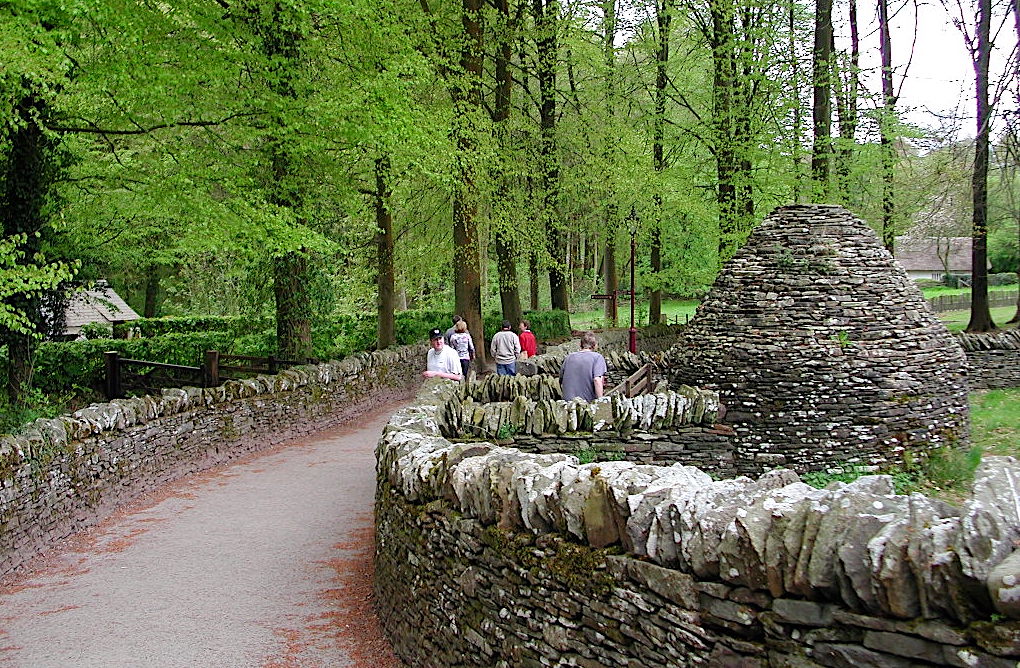
We began the next day by visiting the Welsh Folk Museum in St Fagans near Cardiff. As many of you know, the museum features a wide range of houses, buildings, villages, towns, school houses, farms, and industrial heritage, representing different slices of Welsh history throughout the centuries. Many of these are the actual buildings transported here from their original locations. The museum is perhaps the best multi-era educational resource in Wales, providing children and adults with interactive lessons in the land's diverse history. Although there is a good museum inside the visitor's center, the museum is all about getting outdoors and exploring the buildings. Costumed guides are stationed along the way to provide details of what it was like living at these various times. And yes, there was once a castle at St. Fagans that was replaced by a later manor house and gardens that are now part of the museum. There is a stretch of curtain wall around a portion of the garden that is said to date from the time of the medieval castle. We spent most of the day at St Fagan's before returning to our hotel.
The next morning we drove to Carmarthen for a one night stay at the Ivy Bush Royal Hotel, for again, just one night. We visited Carmarthen because their library contained county census returns. I had recently begun tracing my Thomas Welsh ancestry and initially thought it was a possibility they were from Carmarthenshire. (I was wrong.) These were the days before computer genealogy, and you could only view British census returns either in Britain or at a local LDS (Mormon) library. Although there was little hope of finding anything useful at the library, gave me the opportunity to get my first glimpse of Welsh census records; return's format and the information included.
It was market day the day we arrived and spent time browsing the local produce and crafts, purchasing a couple items along the way. We also visited what we could find of the medieval Carmarthen Castle, which had not yet been freed from the modern encroachments that all but obscured the site.
"The castle is first mentioned in 1094, when the name Rhyd y Gors is used. The earliest castle, built by the Norman William fitz Baldwin, may have been sited elsewhere perhaps further down the river. After 1105 the annals refer to Carmarthen by name, so by then certainly, the Norman castle was on its present site. The castle evidently became important early on, and passed into the hands of the crown. Carmarthen quickly became the administrative center of south-west Wales as it had been under the Romans, and inevitably underwent a series of attacks and rebuilding episodes during the turbulent struggles between Welsh and English in the 12th and 13th centuries."
James 1980, 1989
The main gatehouse and a single stretch of curtain wall (part of a parking lot) was about all we could see. We also visited St Peter's Church which contains the impressive tomb of Sir Rhys ap Thomas (no relation). A controversial character in Welsh history, Rhys was born in 1449 and on his father's death inherited the wealth of the Dinefwr estates. He made a major contribution to Henry's victory at Bosworth in 1485, and was rewarded handsomely by Henry VII, who expanded his Welsh estates as a reward for his services. We returned to the hotel and enjoyed a traditional Welsh diver before calling it a night.
The next morning we departed Carmarthen and headed for our first destination of the day, The National Coracle Centre in Cenarth Falls. This attraction features a museum and workshop of coracles from around the world set in the grounds of a 17th century flour mill beside the beautiful Cenarth Falls famed for its salmon leaps and 200 year old Bridge over the Teifi River. A coracle is a compact paddle fishing boat for usually one man. They are lightweight and once mastered are easy to maneuver for the fisherman. The site is set amid a stunning river location and offers visitors a chance to step back in time and experience what it was like to fish using these centuries-old boats. Although coracles have been used for centuries all over the world, some consider the coracle to be particularly associated with Wales.
Our destination for the next couple of nights was Aberystwyth in west Wales. Our accommodation for this portion of the trip was a two night stay at the lovely Conrah County House Hotel, a stately Edwardian country manor set in 18 acres of grounds. At the time this was definitely the nicest accommodation my wife and I had experienced. The rooms were large and comfortable and the public rooms and restaurant were lavishly appointed. The principal sitting room featured large windows overlooking the grounds to the rear of the house complete with their grazing sheep. We enjoyed dining there and chatting with the owners afterwards. This is where we also learned about the proper order of things for dinner in Britain (which was totally new to my wife and I but not my parents). First, you are shown to the lounge where you order drinks and peruse the night's menu. After a while your waiter takes your order from the lounge, and you continue with drinks. When your appetizer is ready you are shown to your table to begin the meal. I thought this was pretty cool; getting comfortable and ordering from the lounge rather than the table. Nice. After the meal it's time for dessert, but NOT coffee or after dinner drinks. Instead these are enjoyed in the lounge or some similar room only after dessert is finished. (Now I was getting confused.) Anyway, I skipped the coffee and had a nice glass of port instead. Much better. (Why do we look so serious here? Mom seems to be the only one smiling!)
Part II: Aberystwyth & West Wales
The following day we explored in and around the university town of Aberystwyth, also home to the National Library of Wales. My wife and I would return here in later years to check out the Library's genealogy resources as I continued searching for the origins of my Thomas ancestors. We spent quite a bit of time here, walking the high street next to the ocean, shopping, and enjoying a pub lunch at the Central Hotel (Welsh Brewers).
We also visited Aberystwyth Castle located on the edge of town. From a distance there is little to see of the castle, however exploring the grounds reveals some substantial remains of towers, curtain wall, hall blocks, and other structures. This part of Wales changed hands many times which is reflected in the history of the town and castle. At first Aberystwyth was an Iron Age hill fort known as Pen Dinas (Lise Hull). When the Normans arrived a small castle was constructed nearby by Norman Marcher Lord Gilbert de Clare. The first Welsh castle was built by Llywelyn ap Iorwerth (The Great) and changed hands several times between Norman and Welsh. Finally the castle was rebuilt by Edward I in the late 13th century, and it is the ruins of this castle that are visible today.
The following morning we checked out go our hotel and headed for our next accommodation, the fantasy village of Portmeirion in Northwest Wales. On the way we visited one interesting site and two spectacular ones. Our first stop was a Welsh Neolithic site; The Dyffryn Ardudwy Burial Chamber in southern Gwynedd overlooking Cardigan Bay. According to Cadw:
"Located on a hillside overlooking Cardigan Bay, the pair of tombs at this Neolithic (New Stone Age) burial site were built in two distinct stages. The smaller chamber to the west came first. This dolmen (or cromlech) featured two portal stones and a high blocking slab with a capstone rested on top, and was covered by a small, roughly circular cairn. Several generations later the larger tomb to the east was built and buried beneath a wedge-shaped cairn which enveloped its neighbour. Now exposed to the skies, both tombs are extremely well-preserved with capstones still resting securely on their uprights." OK...pretty cool site but it didn't make much of an impression on me at the time, probably because I had yet to investigate ancient Wales and was primarily fixated on castles. That would change in the years to come. My wife and I revisited the site later, and by then I had a much better understanding and appreciation for these ancient monuments.
Part III: North Wales & Portmeirion
Then things got serious. Our second stop of the day was Harlech Castle in west Wales. My senses had already been dazzled by our first day's visits to Tintern, Chepstow and Caerphilly, and I doubted that there would be a repeat of this later. I was wrong. Again, seeing photographs and reading about Harlech did nothing to prepare me for actually being there. Harlech is simply magnificent, a world-class, World Heritage site, and, like Caerphilly, simply one of the most grand and impressive castles in all of Europe. As we approached the castle from the car park I marveled at the massive tell towers, gatehouse, and the (now reduced) curtain wall surrounding the castle. The castle sits perched dramatically on a cliff overlooking the estuary. When the castle was constructed the estuary ran just beneath the castle so it could be easily re-supplied from the sea. This was a hallmark of Edwardian castles including, Rhuddlan, Conwy, Caernarfon, Flint, and Aberystwyth. What strikes people first is the castle's massive and seemingly impenetrable gatehouse, protected by a curtain wall, twin towers, a portcullis, and passageway featuring murder holes above. Once inside the castle the rear gatehouse complex is just as impressive with twin double towers and rear wall that extend above the wall walk surrounding the top of the castle.
There are the typical interesting castle structures inside the castle courtyard, but at Harlech, the real star here the castle wall walks. You can take either the sometime outer staircase of the interior conical stairs inside the walls to get there. (If it's raining it's safer to take the interior stairs.) Either way you climb you will be rewarded with some spectacular views of the surrounding countryside along with an understanding of why this castle was so defensible; so difficult to take. Harlech (the actual castle) was technically never defeated in battle, however the castle was surrendered (due to a prolonged siege) on two notable occasions; once by forces loyal to Welsh patriot Owain Glyn Dwr, and during the Wars of the Roses when it was surrendered by Lancastrian forces.
I should mention that Harlech was my dad's favorite castle and his favorite place in all of Wales. I think it was a combination of the grandeur of the castle and its long, eventful history. It was one of the few instances on the trip where he was mostly silent, simply contemplating the atmosphere and the history that surrounded him. (Wales does that to you.) Almost every time my mom and dad traveled to Wales, Dad managed to make time for Harlech, even if they were traveling with a group. I can definitely understand why. We spent about an hour exploring the castle then walked around the town before having lunch at the Prince of Wales pub. Afterwards we got back in the car and continued north with one last site to visit before checking into Portmeirion.
Our final stop of the day was Criccieth Castle located on the Llyn Peninsula in northwest Wales. The castle sits high on a cliff overlooking the Tremadog Bay in the seaside town of the same name. Although the ruins here are not as complete or as impressive as Harlech, the castle's dramatic defensive positioning is. Criccieth was originally (likely) built by the Welsh prince Llywelyn ap Iorwerth (The Great) and added to by his grandson Llywelyn ap Gruffydd (The Last). The castle's most dominating feature is its large twin tower gatehouse. Most feel that the gatehouse was built by Llywelyn ap Gruffydd in around 1230, while others claim it was constructed by the English King Edward I. We do know that as the tide of Anglo-Welsh relations swung back and forth, the castle changed hands several times ,and the castle's final building period was completed by the English following the second Welsh War of 1282-83.
We paid our admission at the gift shop and began the steep winding climb to the castle. One you get past the magnificent gatehouse the rest of the ruins are less impressive, although this deficiency is more than offset by the spectacular position the castle enjoys with breathtaking views in all directions. This is another castle that could be resupplied by the sea, so, although Edward didn't build the castle, like Aberystwyth, it is easy to see why he wanted it. We lingered here for a while before returning to the car and heading for our accommodations.
The Village of Portmeirion is something of an Italianate fantasy village created by Sir Clough Williams-Ellis on land he purchased in here 1925. He erected a collection of fanciful and sometimes bizarre buildings including several cottages. Portmeirion was famously used for the 1960s British spy drama, "The Prisoner," a series I vaguely remembered from my childhood. The village includes the Hotel Portmeirion, today a 4-Star hotel. Our rooms were in the hotel overlooking the estuary, rather than the cottages scattered throughout the village which are also available for rent holiday let. We enjoyed dinner at the hotel which had been recently rebuilt after being devastated by a fire. The restaurant had recently reopened and I don't remember of the food was good, but I do remember that the dining room was unreasonably hot and the wine that was served was warm. All perhaps growing pains for the new restaurant. We enjoyed walking the grounds of the village, enjoying the formal and wild gardens and exploring the colorful buildings; some real, some just facades. We spent only one night in Portmeirion before leaving Wales.
Part IV: Oxford & London
After leaving Wales our final two destinations were Oxford and London. Although Harlech was dad's favorite place in Wales, Oxford was definitely his favorite city. Mom and dad went there time and time again, usually staying at The Randolph Hotel (as we Americans tend to do - we just don't know any better) and that's were we stayed this time. This time we enjoyed a two night stay. I have to admit that the location is hard to beat. Close to the high street and directly across from the Ashmolean Museum. Besides, what respectable fan of Colin Dexter's "Inspector Morse" would not want to stay there?
In Oxford we took in all the usual sites. The aforementioned Ashmolean was certainly special. My dad was a great fan of museums, and so am I. It was a bit thrilling to see a portion of the Sutton Hoo burial treasure, the archaeological discovery that helped unlock secrets of Anglo-Saxon society. We also visited the Bodleian Library, the Oxford University Museum of Natural History and the quirky Pitt Rivers Museum. We enjoyed a side trip to Blenheim Palace in nearby Woodstock, seat of the Dukes of Marlborough. This was our first grand house tour in Britain and dad picked a good one. Historic, huge and spectacular I would say. And of course we had dinner one night at the Trout Inn in Wolvercote, still paying homage to Morse. Didn't see any ancient jewelry in the river though.
We dropped off our rental car in Oxford and took the train to London for our final three days days in Britain at the St Ermins Hotel, close to New Scotland Yard. Having never visited London we did the usual first-time tourist stuff, and that was fine, or rather great! Westminster Abbey, The Tower of London, Buckingham Palace, The Strand, St Paul's Cathedral, Trafalgar Square, The British Museum (great), Greenwich and Greenwich Palace. Here again, the British Museum was probably my favorite because I had the chance to explore history and artifacts from the Celtic and Saxon Eras, as well as the Middle Ages. Plus, I got to see the Rosetta Stone (before it was placed in a glass case), the key to finally decoding Egyptian hieroglyphs. And don't forget the magnificent Parthenon Sculptures (which used to be called The Elgin Marbles). British history is what I enjoyed here the most, while dad was always a big fan of the Egyptian collections.
Although it was something of a quick trip to Britain, one night here, two nights there, we had packed an incredible amount if history and sight-seeing into a 10-day trip. Mom and dad did an absolutely wonderful job of creating a fantastic itinerary. Do I need to say that Wales was my favorite part? Hope not. The trip whetted our appetite for returning to Wales time and time again. On later trips my wife and almost always took two weeks and stayed longer in places, doing more driving to reach sites on our itinerary. In any case, there is no doubt that The Castles of Wales website was given a huge boost as a result of out first trip to Wales. Diolch yn fawr iawn!
View our itinerary of places visited and our route map
Home | Main Menu | Castle Index | Historical Essays | Recommended Castles | What's New | Links
Copyright © 2009 by Jeffrey L. Thomas